Award-winning designs that grab attention
The Dodgeball Marble Run Race
Two teams. Two dodgeballs. One epic race.
Two teams race to design and build a life-sized marble run for a dodgeball using only Superspace panels. First ball to cross the finish line wins. Teams sketch, build, test, and revise as they apply the engineering design cycle and learn how angle and height affect speed.
-
Standards: NGSS 3-5-ETS1-3, NGSS 4-PS3-1, CCSS SL.4.1
-
Group size: 2 teams of 4 to 8
-
Time: 45 to 60 minutes
-
Materials: 1 Classroom Set per team + 2 dodgeballs
Build the tallest tower that can survive a 10-second shake test.
The Earthquake-Proof Tower
Teams design and build a free-standing Superspace tower that has to stay upright through a teacher-led "earthquake" (a shaken floor mat or rolling cart). Bonus points for towers that protect a stuffed animal "resident" inside.
-
Focus: Structural engineering, geometry, measurement, iteration
-
Group size: 3 to 4 students per team
-
Time: 30 to 45 minutes
-
Materials: 1 Classroom Set per 2 teams + a small plush
Design a maze. Trade with another team. Solve it with voice commands.
The Walk-Through Maze
Teams design a walk-through maze using Superspace panels, then swap mazes. One student is blindfolded inside the maze, guided only by a teammate's voice from outside. It is spatial reasoning, computational thinking, and precise communication, with no screen involved.
-
Focus: Spatial reasoning, computational thinking, communication
-
Group size: 2 teams of 4 to 6
-
Time: 45 minutes
-
Materials: 1 Classroom Set per team
Build a bridge that holds the most weight before it fails.
The Bridge Build
Two teams design and build a free-standing Superspace bridge that spans a marked gap on the floor. They test by adding weight (textbooks, water bottles) one at a time until the bridge collapses. Highest weight before failure wins.
-
Standards: NGSS 3-5-ETS1-3, MP.4 (model with mathematics), 4.MD.A.2
-
Group size: 2 teams of 4 to 6
-
Time: 45 minutes
-
Materials: 1 Classroom Set per team + textbooks or water bottles for weight
Featured in
WHY IT WORKS
Click-and-build simple.
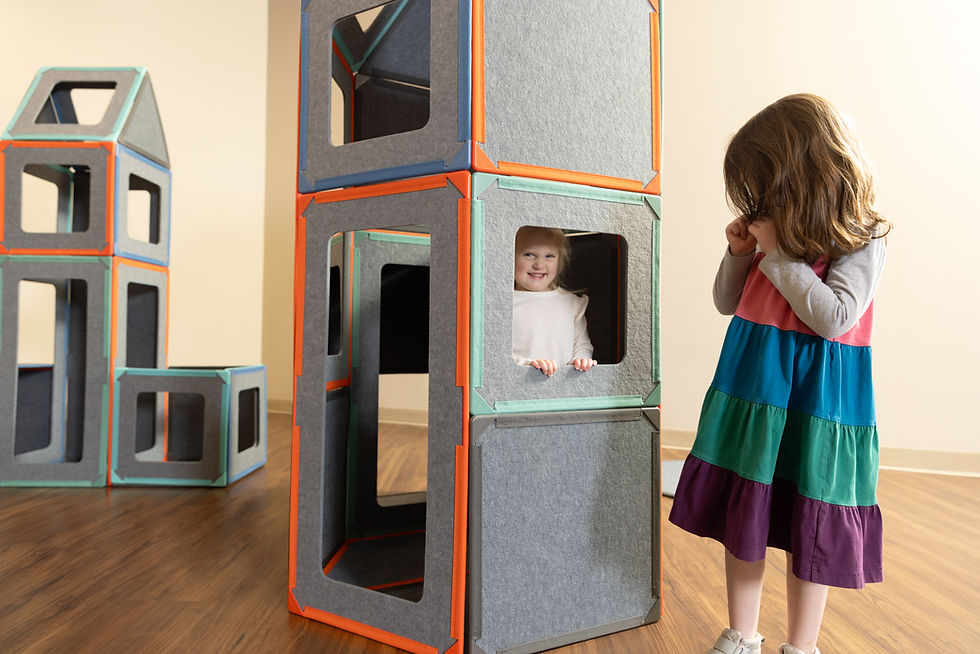
Patented auto-aligning magnets mean kindergartners can build independently. No instructions, no frustration.
Built classroom-tough.
Premium eco-felt construction made with recycled plastic bottles, designed to hold up to daily classroom use.
Stores flat.
Panels slide into a closet, under a bookshelf or in its carrying case box. Easy clean up when class is over.
Educator Testimonials
Shop Educator Bundles



STEM and STEAM curriculum aligned Lesson Plans
Exploring 2D and 3D Shapes with Superspace
K.G.B.4 — Analyze and compare two- and three-dimensional shapes using informal language to describe their similarities, differences, and attributes.
1.G.A.2 — Compose two-dimensional or three-dimensional shapes to create a composite shape, and compose new shapes from the composite shape.
K.G.A.2 — Correctly name shapes regardless of their orientations or overall size
Grade Level: Kindergarten – 1st Grade
Duration: 30–40 minutes
Subject : Mathematics / STEM / Spatial Reasoning
Students use life-sized magnetic Superspace panels to build and compare 2D and 3D geometric shapes, developing spatial reasoning and geometric vocabulary through hands-on collaborative construction
Building a Rocket Together: Exploring Teamwork
ELOF: Social & Emotional Goal P-SE 4 — Child engages in cooperative play with other children.
NGSS K-2-ETS1-1 — Ask questions, make observations, and gather information about a situation people want to change to define a simple problem that can be solved through the development of a new or improved object or tool.
ELOF: Approaches to Learning Goal P-ATL 7 — Child demonstrates persistence and flexibility in approaching tasks
Grade Level: Pre-K (Ages 4–5)
Duration: 45 minutes
Subject: Social-Emotional Learning / Creative Play / STEM
Pre-K students work in small teams to build a life-sized rocket using Superspace, developing cooperative play, communication, and early engineering thinking through role-based group challenges and guided reflection.
Engineering with Empathy: Design Challenge
NGSS K-2-ETS1-1 — Ask questions, make observations, and gather information about a situation people want to change to define a simple problem that can be solved through the development of a new or improved object or tool.
CCSS.ELA-LITERACY.SL.1.1 — Participate in collaborative conversations with diverse partners about grade 1 topics and texts with peers and adults in small and larger groups.
CCSS.ELA-LITERACY.SL.2.4 — Tell a story or recount an experience with appropriate facts and relevant, descriptive details, speaking audibly in coherent sentences
Grade Level: Kindergarten – 2nd Grade
Duration: 45–60 minutes
Subject: STEM / Social-Emotional Learning / Language Arts
Students work in small groups to design and build a purposeful Superspace structure that solves a real problem, developing empathy, critical thinking, and verbal communication skills through collaborative planning, construction, and structured group presentation.
Life-Sized Marble Run Race
NGSS 3-5-ETS1-3 — Plan and carry out fair tests in which variables are controlled to identify failure points, suggest improvements, and generate ideas for meeting criteria for success.
NGSS 4-PS3-1 — Use evidence to construct an explanation relating the speed of an object to the energy of that object, and how angle and height affect motion and energy transfer.
CCSS.ELA-LITERACY.SL.4.1 — Engage effectively in a range of collaborative discussions with diverse partners on grade 4 topics and texts, building on others' ideas and expressing their own clearly
Grade Level: 3rd – 5th Grade
Duration: 45–60 minutes
Subject: STEM / Science / ELA Group
Two teams race to design and build a life-sized marble run using only Superspace panels, then send a dodgeball rolling to the finish line — applying the engineering design cycle as they discover how angle and height affect speed
Screens off. Hands on.
Long live building in the classroom.
Subscribe to our monthly newsletter
A new lesson plan every month, plus early access to new challenges and educator-only discounts.
Direct to your inbox.
Shop All Sets


Explore STEAM + STEM research backed Blog


Get in touch!
Reach out any way that works for you. Submit a question through the form below, email or call from our business card, or pick a time on the calendar to talk it through.